
Riverside County Superior Court Overview
The Superior Court of California, County of Riverside is the single countywide trial court of general jurisdiction. It hears civil money disputes, real property cases, contract claims, civil rights claims, torts, small claims, eviction matters, criminal cases at every level, traffic, family law, probate, juvenile, mental health, the CARE Act, grand jury proceedings, and enhanced collections. Riverside has more than 2.4 million residents over about 7,300 square miles, so the court spreads across 13 buildings to keep counters within reach of most residents. The home page sits at riverside.courts.ca.gov.
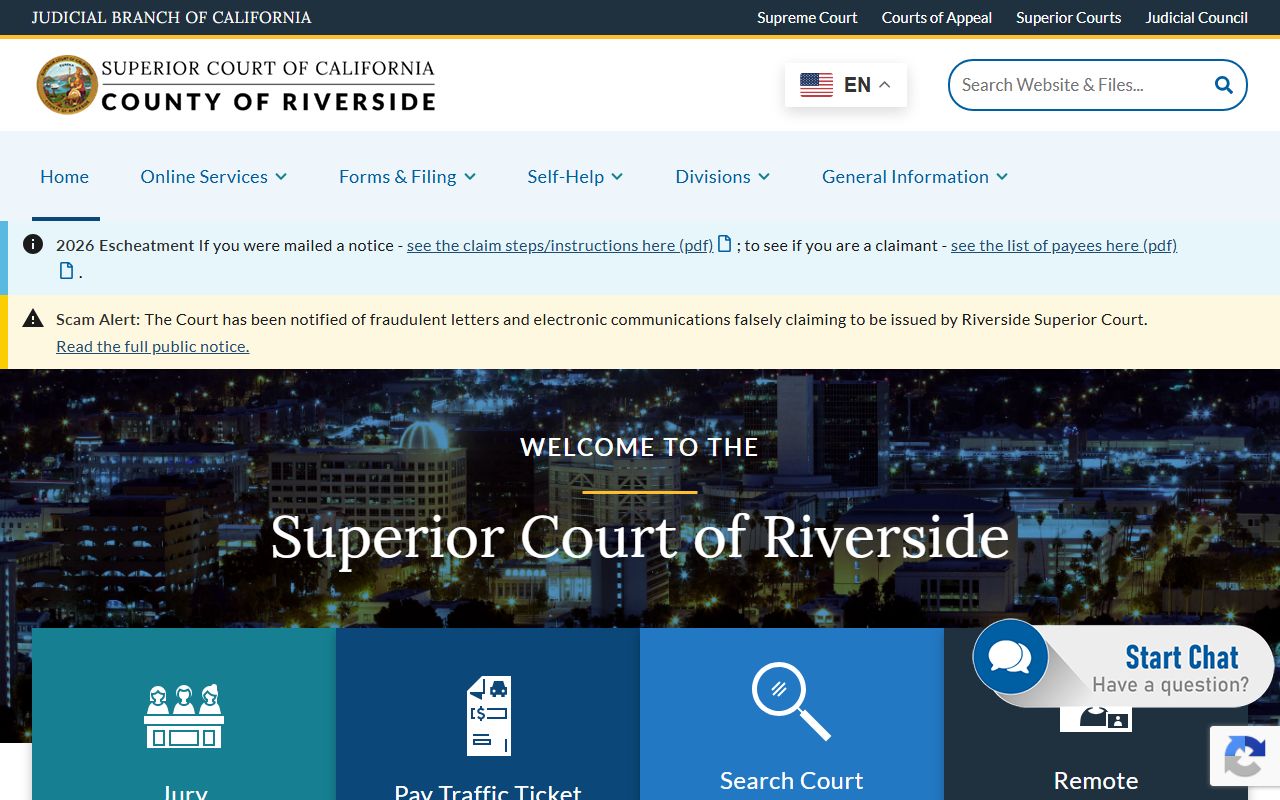 The court home page links to jury service, traffic payment, public access, remote appearances, self-help, interpreters, and court locations.
California Unified Court System and Riverside County
Older Riverside court files sometimes mention municipal courts. Those are gone. California voters passed Proposition 220 in 1998, which let the judges in each county vote to unify the trial courts. Riverside, like every other county, ended up with a single Superior Court. The old Riverside Municipal Court records were folded into the Superior Court case management system. Today, what some users still call a "Riverside district court" or "Riverside municipal court" is simply the Superior Court of California, County of Riverside. Small claims, limited civil, and traffic infractions are divisions of the Superior Court, not separate lower courts.
The clerk function for case records is performed in-house by the Court Executive Officer, who carries the title Clerk of the Superior Court. The Assessor-County Clerk-Recorder is a separate elected county office that holds non-court records such as deeds, marriage licenses, fictitious business names, and notary registrations. The Sheriff is a third elected office and holds jail, booking, civil-process, and bench warrant service records.
Riverside County Superior Court Locations
The court runs counters at 13 buildings. Counter hours run Monday through Friday, 7:30 a.m. to 4:00 p.m., with some outlying counters on a shorter week. The shared phone number is 951-777-3147; Palm Springs also publishes 760-393-2617. Drop boxes are available at all but the Southwest Juvenile courthouse.
| Building | Address | Phone | Matters Served |
|---|---|---|---|
| Riverside Historic Courthouse | 4050 Main Street, Riverside, CA 92501 | 951-777-3147 | Civil, probate, court executive offices, HR. |
| Riverside Hall of Justice | 4100 Main Street, Riverside, CA 92501 | 951-777-3147 | Criminal; public viewing computers and drop box. |
| Riverside Family Law Courthouse | 4175 Main Street, Riverside, CA 92501 | 951-777-3147 | Family law: dissolution, custody, support, DV. |
| Riverside Juvenile Courthouse | 9991 County Farm Road, Riverside, CA 92503 | 951-777-3147 | Juvenile delinquency and dependency. |
| Banning Justice Center | 311 E. Ramsey Street, Banning, CA 92220 | 951-777-3147 | Civil, criminal, traffic, family for the Pass area. |
| Blythe Courthouse | 265 N. Broadway, Blythe, CA 92225 | 951-777-3147 | Civil, criminal, traffic for east county. |
| Corona Courthouse | 505 S. Buena Vista Ave. #201, Corona, CA 92882 | 951-777-3147 | Civil, small claims, traffic. |
| Larson Justice Center | 46-200 Oasis Street, Indio, CA 92201 | 951-777-3147 | Criminal, civil, family for the desert. |
| Menifee Justice Center | 27401 Menifee Center Drive, Menifee, CA 92584 | 951-777-3147 | Criminal, traffic, civil for mid-county. |
| Moreno Valley Courthouse | 13800 Heacock St., Bldg. D #201, Moreno Valley, CA 92553 | 951-777-3147 | Traffic and limited civil. |
| Palm Springs Courthouse | 3255 E. Tahquitz Canyon Way, Palm Springs, CA 92262 | 760-393-2617 | Civil, small claims, probate, family. |
| Southwest Justice Center | 30755-D Auld Road, Murrieta, CA 92563 | 951-777-3147 | Civil, criminal, family, probate. |
| Southwest Juvenile Courthouse | 30755-G Auld Road, Murrieta, CA 92563 | 951-777-3147 | Juvenile delinquency and dependency for southwest. |
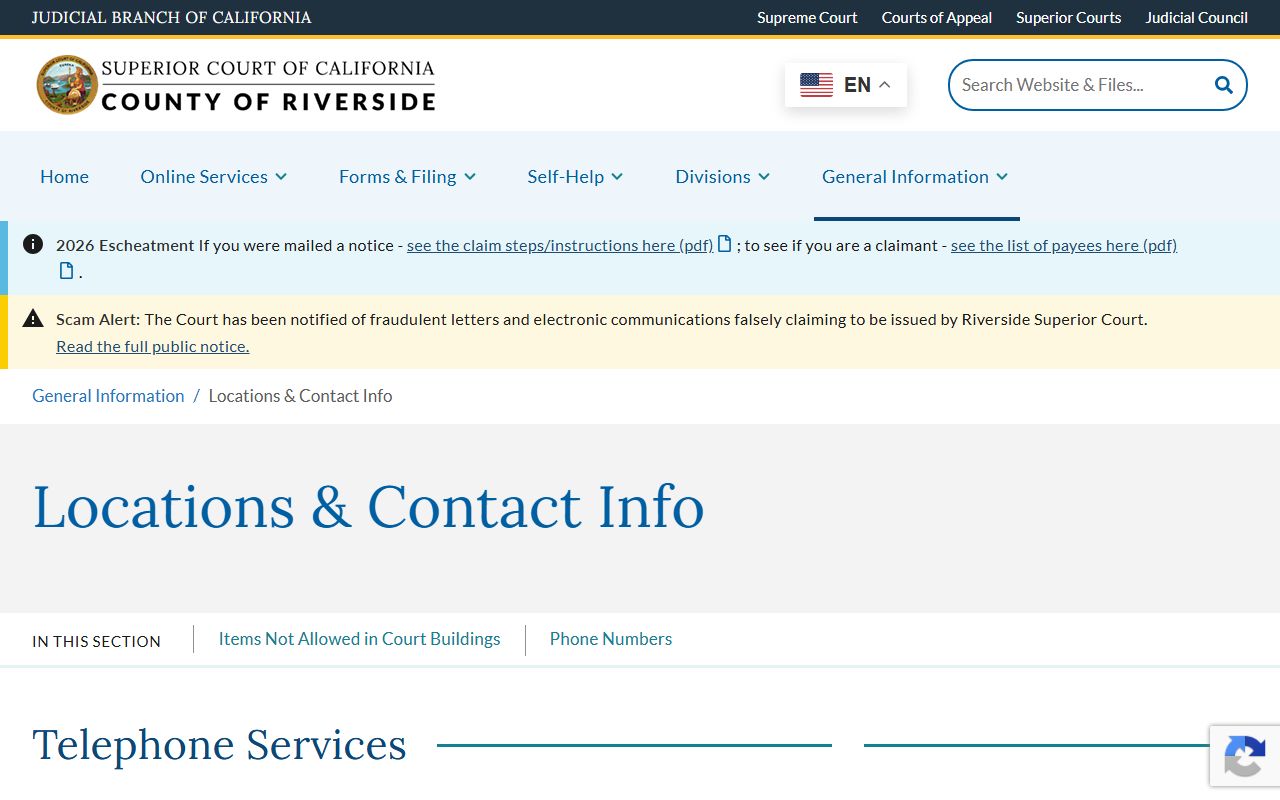 The court locations page lists drop-box status and counter hours for each building.
Riverside County Superior Court Divisions
The Superior Court splits its work into divisions, not separate courts. Each division has its own forms, calendars, and local rules. The division index at riverside.courts.ca.gov/divisions lists every active division.
- Civil. Money disputes, real property, contract, civil rights, tort, small claims, and unlawful detainer.
- Criminal. Felony, misdemeanor, and infraction; the Hall of Justice is the main criminal courthouse.
- Family Law. Dissolution, legal separation, nullity, parentage, custody, support, and domestic violence.
- Probate. Estates, trusts, guardianships, conservatorships, minor compromises, and LPS mental health.
- Juvenile. Delinquency and dependency under Welfare and Institutions Code §827.
- Traffic. Infractions, misdemeanor traffic, trial by declaration, and payment plans.
- CARE Act. Petitions filed at any courthouse; CARE proceedings are confidential and not open to the public.
The Grand Jury sits as a separate body that reviews county and city operations and may return criminal indictments. Enhanced Collections handles court-ordered debt, including fines, fees, and restitution. Specialty courts include Veterans Treatment Court, Drug Court, Mental Health Court, and Homeless Court, which run on a collaborative model with treatment, supervision, and graduations after a minimum 18-month program.
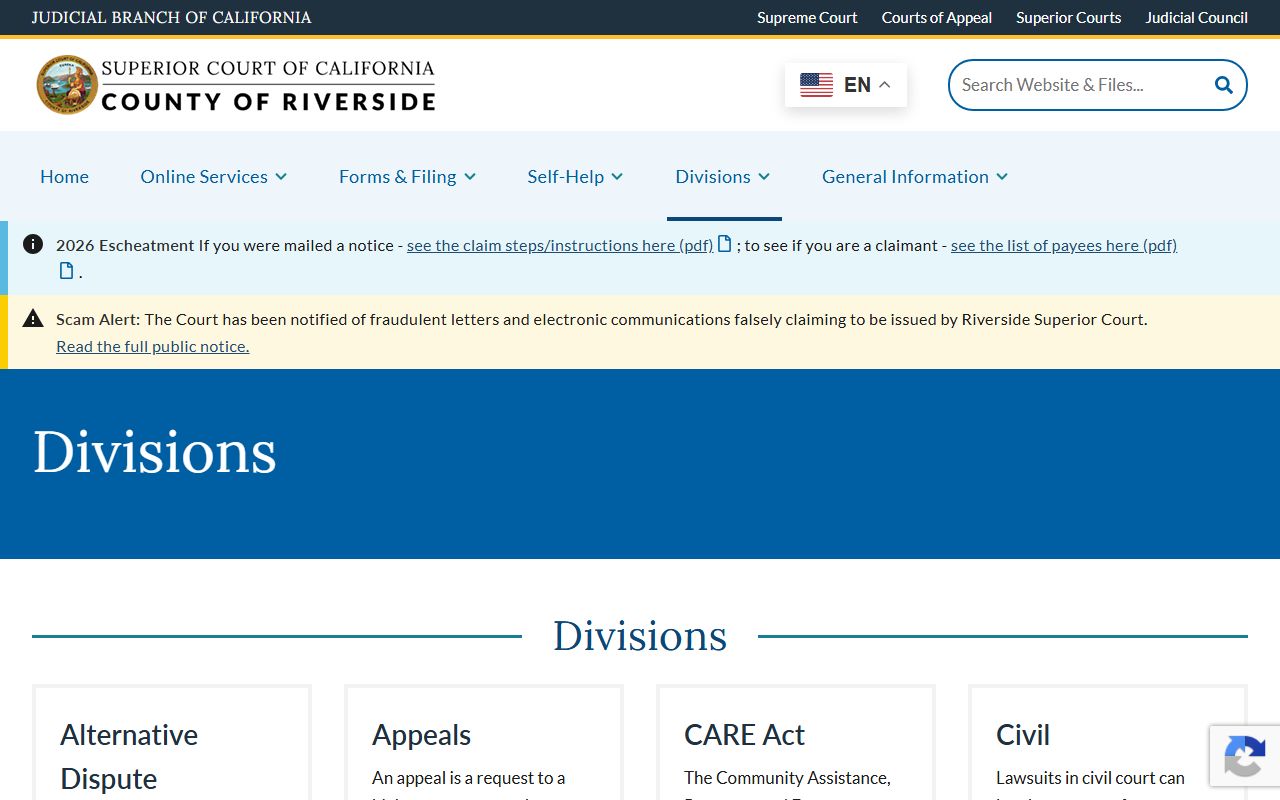 The division index page gathers civil, criminal, family law, probate, CARE Act, grand jury, and enhanced collections.
Superior Court vs. ACR vs. Sheriff in Riverside County
Three offices hold the records most users look for. Each holds a different slice. Sending a request to the wrong office wastes time. The comparison below maps who holds what.
| Superior Court | Assessor-County Clerk-Recorder | Sheriff | |
|---|---|---|---|
| Case files | All civil, criminal, family, probate, traffic, juvenile, CARE | None | None |
| Marriage licenses | No | Yes; public and confidential | No |
| Deeds and recorded docs | No | Yes | No |
| Fictitious business names | No | Yes | No |
| Vital records (birth/death) | No | Yes, within statutory window | No |
| Jail bookings | No | No | Yes; JIMS inmate search |
| Bench warrant service | Issues warrant | No | Serves warrant |
| Public records portal | Public Portal for cases | ACR official records search | Sheriff department forms |
| Phone | 951-777-3147 | 951-486-7000 (Gateway) | Department-specific |
How a Case Moves Through the Riverside County System
Every case starts at the Superior Court. From there, the file moves through trial, judgment, and, if a party asks, an appeal. California's appeal route from Riverside goes through the Fourth Appellate District, Division Two, located in downtown Riverside on Vine Street. The Supreme Court of California is the last step.
Process diagram. Filing at Superior Court › Pretrial motions and discovery › Trial › Judgment or sentence › Notice of appeal › California Court of Appeal, Fourth District, Division Two › Petition for review › Supreme Court of California.
Criminal flow. Arrest › Booking at a Sheriff facility › Arraignment in Superior Court › Bail or release on own recognizance › Pretrial and preliminary hearing › Trial › Sentencing › Appeal to Fourth District, Division Two.
Civil flow. Complaint filed › Answer or default › Case management conference › Discovery › Mediation or settlement conference › Trial › Judgment › Notice of appeal › Fourth District, Division Two.
Family flow. Petition for dissolution or custody › Response › Financial disclosures › Temporary orders › Settlement or trial › Judgment › Appeal or post-judgment motions.
Appeals from Riverside County Superior Court
Appeals from Riverside Superior Court are heard by the California Court of Appeal, Fourth Appellate District, Division Two. The division is based in downtown Riverside and covers Riverside, San Bernardino, and Inyo Counties. A party who loses a Riverside trial-court case may file a notice of appeal with the trial-court clerk under the time limits in the California Rules of Court. Civil cases use a 60-day notice window in most situations; criminal cases use a 60-day window as well, with shorter windows for some interlocutory appeals.
After the Court of Appeal rules, the losing party may file a petition for review with the Supreme Court of California in San Francisco. The Supreme Court takes only a small percentage of petitions, mostly cases that present statewide importance or a split in the appellate districts. Some criminal cases bypass intermediate review under the death-penalty automatic-appeal rule, but those are rare.
Public Access at the Riverside County Superior Court
The court runs the Public Portal at epublic-access.riverside.courts.ca.gov. The portal gives the public an index search, register of actions, calendar, document downloads, and probate notes. An account is required. Case-number searches are free; name searches use credits at $1 each and up. Document downloads run $1.00 per page for the first 5 pages and $0.50 per page after, capped at $50 per document. The portal limits a user to 30 lookups every 5 minutes.
For files outside the online date range or purged under Government Code §68152, the court runs a Request Records Search at rrs.riverside.courts.ca.gov for $15 per search. Self-Help Legal Services is open at the Riverside Self-Help Center and online at riverside.courts.ca.gov/self-help. Self-help covers family law, evictions, small claims, name changes, guardianship, conservatorship, probate, and restraining orders.
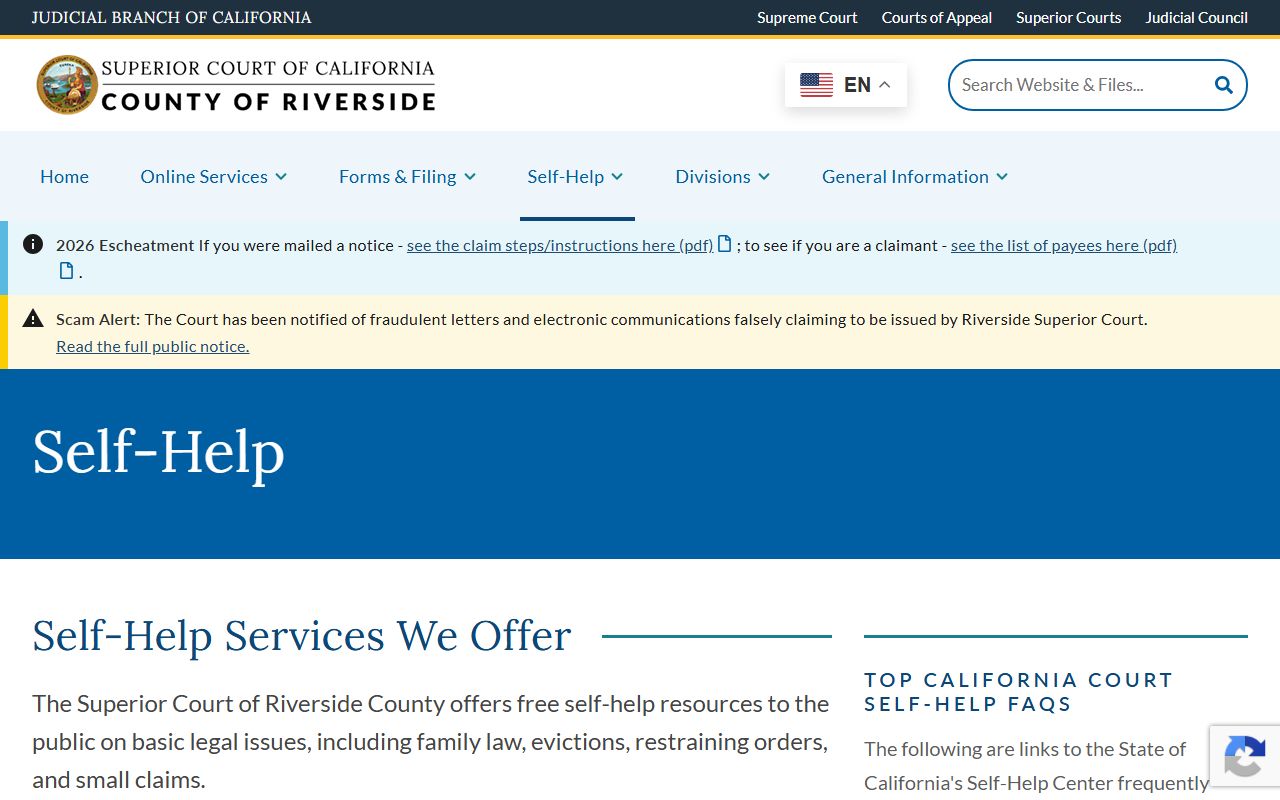 The self-help page gathers case-type resource cards and links to the state self-help site.
Note. The Public Portal is a research tool, not the official record. For an official certified record, go to the courthouse or mail a request to the clerk.
Specialty Courts in Riverside County
Riverside runs several specialty calendars that handle a single class of cases with treatment-court rules. Veterans Treatment Court takes eligible veterans with service-related issues and runs at least an 18-month program with treatment partners and a graduation. Drug Court, Mental Health Court, and Homeless Court use a similar model. The CARE Act calendar, started under Senate Bill 1338, lets a small group of petitioners ask the court to order a care plan for a person with untreated severe mental illness. CARE filings carry no fee and may be lodged through eSubmit at any courthouse.