
California Public Records Act and Riverside County
California public access for non-court county records sits in the California Public Records Act, now codified at Government Code §7920.000. The CPRA was recodified by Stats. 2021, Chapter 614 (AB 473), with sections operative January 1, 2023. The act presumes records held by state and local agencies are open to inspection by any person, with limited exemptions. For Riverside County, the CPRA covers records held by county departments such as the executive office, public health, social services, and the administrative side of the Sheriff and DA.
Court case records are different. They are governed by common-law access principles, statutes, and the California Rules of Court, especially rules 2.500 through 2.507 for electronic trial court records and rule 10.500 for judicial administrative records. Riverside County's public records page makes this split plain: the county does not maintain court records, and court files must be requested from Riverside Superior Court. Anyone can ask for a Riverside County public record. There is no need to show a reason or a residency. Some categories are restricted by law, but the default is open access.
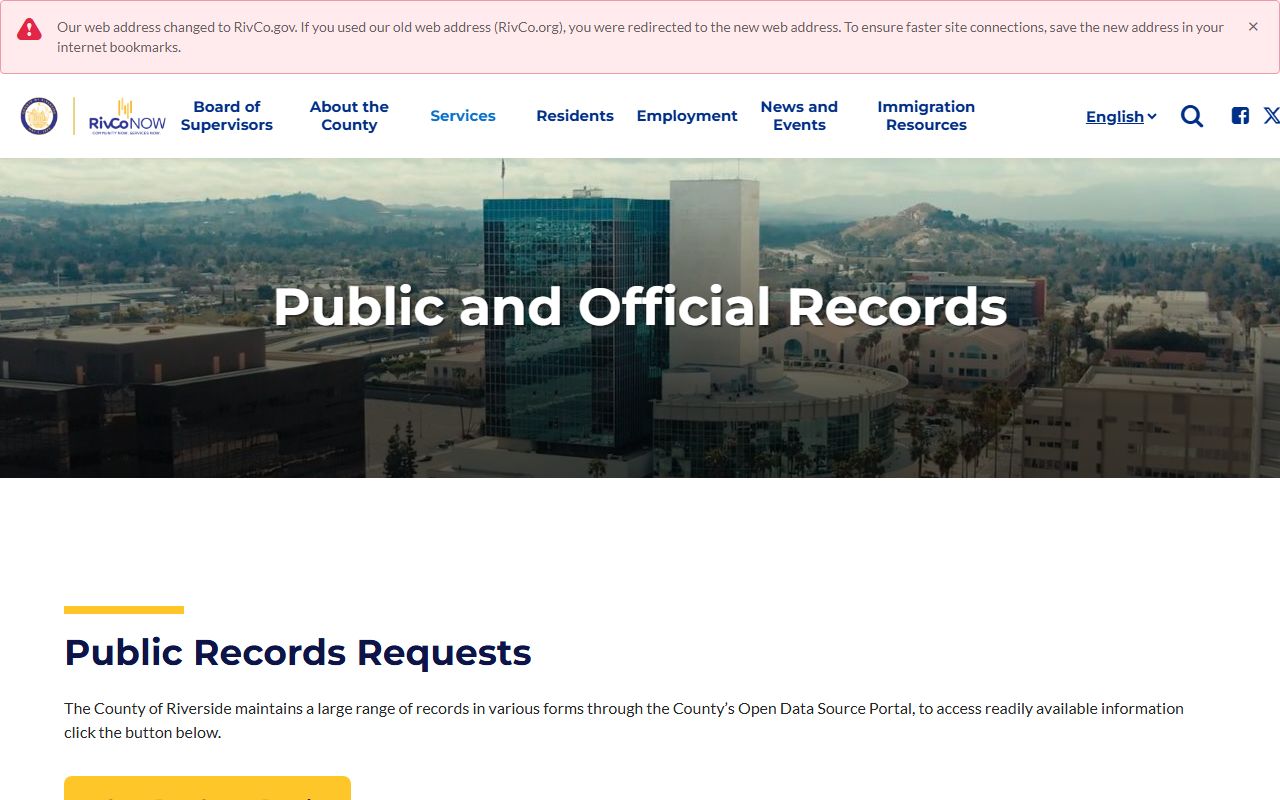
The county page splits records by holder: county department records, ACR vital and official records, public health vital records, court records, DA requests, and Sheriff requests. Picking the right holder is the first real step. A request sent to the wrong office only stretches the timeline.
What Records Riverside County Maintains
Riverside County records cover a wide mix of subjects. Most fall into one of three groups: general county department records, ACR recorded and clerk records, and court case files. The county's public records page links to each holder. Knowing which group your request lives in saves rework.
- County department records. Contracts, budgets, board agendas and minutes, emails, performance audits, public health data, and administrative files held by general county offices.
- ACR official records. Deeds, deeds of trust, releases, reconveyances, liens, maps, and other recorded land documents indexed from January 1, 1974 forward.
- ACR clerk records. Fictitious business names, notary registrations, environmental filings, marriage licenses, and related clerk filings indexed from January 1, 1893 forward.
- Vital records. Birth, death, marriage, and confidential marriage records held by ACR and Public Health Vital Records.
- Court case records. Civil, criminal, traffic, family, probate, and juvenile case files held by Riverside Superior Court.
- Sheriff and DA records. Incident reports, arrest reports, jail data, and investigation records, with law-enforcement exemptions under Government Code §7923.600 and following.
How to File a Riverside County Public Records Request
Most non-court county records flow through the NextRequest portal at riversidecountyca.nextrequest.com. NextRequest lets a requester submit, track, and download responses online. Each request gets a tracking number, status updates, and a record of any communication with the assigned department. The portal is the cleanest route for general county department records. Court records, ACR records, and Sheriff or DA records have separate paths.
- Identify the holder. County department records go through NextRequest. Court files go through the Superior Court. ACR records go through ACR search and copies. Sheriff or DA records go through that agency's records unit.
- Describe the records clearly. Name the document type, the topic, the time window, and any names or case numbers. A vague request slows the response.
- Submit through the right channel. For NextRequest, create a portal account or submit as an anonymous requester. Note that the portal page is public by default.
- Watch for a status update. The county may ask follow-up questions to narrow the scope, estimate the time needed, or describe likely fees.
- Pay any fees and download or pick up the records. NextRequest delivers many responses as digital files; large packets may be split across messages.
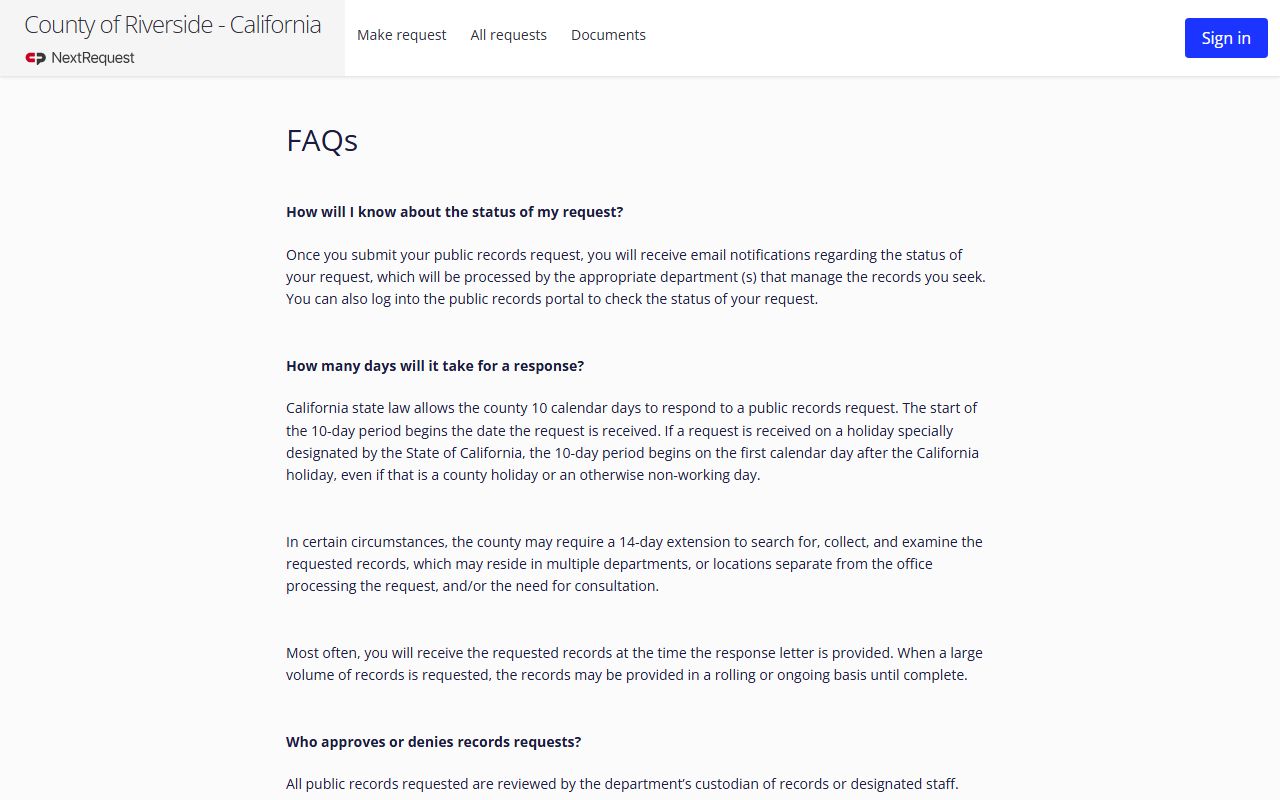
The NextRequest FAQ explains that requests and most responses on the portal are public by default. People who want a confidential channel for a personal records search should think about which path fits the request. The FAQ also explains how to track a request and what status labels mean.
Riverside County Public Records Request Form Fields
The NextRequest form is short, but each field matters. A complete entry helps the county route the request to the right department and avoids back-and-forth. The table lists the practical fields used in Riverside County public records requests.
| Field | Required | Notes |
|---|---|---|
| Requester Name | Suggested | NextRequest allows anonymous submission; a name helps with follow-up. |
| Contact Email | Yes | Used for status updates and links to released records. |
| Phone | No | Optional; useful for narrowing or clarifying scope. |
| Mailing Address | No | Add when you need paper copies sent by mail. |
| Department | Suggested | Pick the department you think holds the record; the county can re-route. |
| Description of Records | Yes | Be specific: type of record, subject, names, case numbers, locations. |
| Date Range | Suggested | Narrow the time window to speed the search. |
| Format Preference | No | State if you want PDF, native format, or paper copies. |
| Public or Private | Default | Requests are public by default on the portal. |
For court records, use the court's Request Records Search path or visit a clerk counter. For ACR records, use the ACR Official Records Search and Copies system or the Clerk Records Search and Copies system. For local summary criminal history under Penal Code §13300, the court provides form RI-CR093 at riverside.courts.ca.gov.
Riverside County Public Records Response Timelines
The CPRA gives an agency 10 calendar days to decide whether to comply with a request and to tell the requester. The agency can extend that period by up to 14 days in unusual circumstances, such as a need to search separate offices, review a large volume of records, consult with another agency, or work with another office that has a substantial interest in the determination. The decision deadline is not the same as the production deadline. Once the agency decides to comply, it must produce promptly. The CPRA says records must be made available in a reasonable timeframe.
Requests under California Rules of Court rule 10.500 for judicial administrative records follow their own response steps. Court case-record requests have separate clerk timelines and counter hours of 7:30 a.m. to 4:00 p.m. Phone hours at the court run 7:30 a.m. to 2:00 p.m. on weekdays.
Riverside County Public Records Fees
Riverside County public records fees depend on the holder and the record type. ACR official records charge $8.00 for the first page of a recorded document, $1.00 for each additional page in the same document, and $2.00 per document for certification. ACR clerk records charge $2.00 for the first page, $1.00 for each additional page in the same document, and $2.00 for certification, with the same $2.00 fee for a certified copy of a Fictitious Business Name Statement. Marriage and Deputy Commissioner fees are set separately by ACR.
| Item | Amount |
|---|---|
| Official records copy, first page | $8.00 |
| Official records copy, each additional page in same document | $1.00 |
| Official records certification | $2.00 per document |
| Clerk record copy, first page | $2.00 |
| Clerk record copy, each additional page in same document | $1.00 |
| Clerk record certification | $2.00 per document |
| Certified Fictitious Business Name Statement copy | $2.00 |
| Public marriage license | $111.00 |
| Deputy Commissioner for the Day | $62.00 non-refundable |
| Credit or debit convenience fee | 2.15% third-party processing |
| Court Public Portal name search credit (1) | $1.00 |
| Court Records Search by clerk | $15.00 per name |
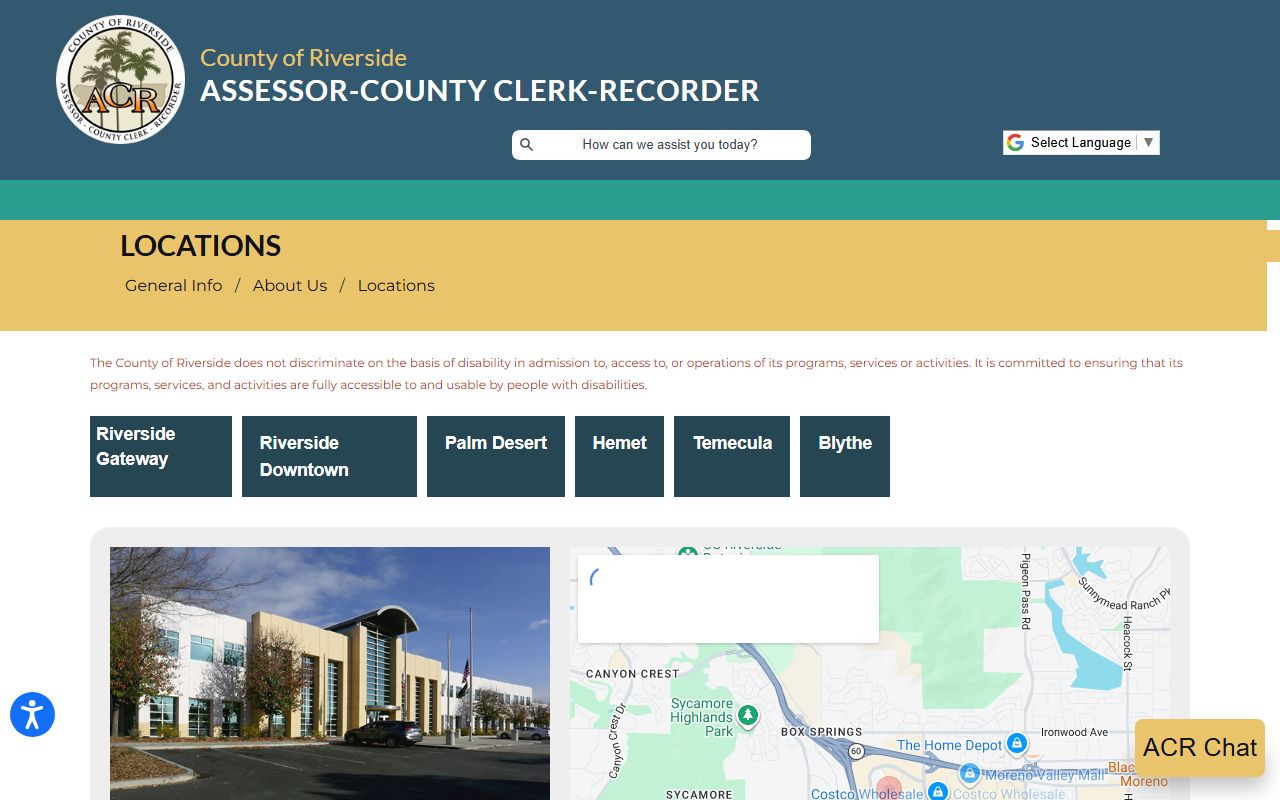
The ACR locations page lists offices in Riverside Gateway, Riverside Downtown, Palm Desert, Hemet, Temecula, and Blythe. The main Riverside Gateway office at 2724 Gateway Drive runs 8:00 a.m. to 5:00 p.m. Appointments are encouraged at each location. The Blythe office runs limited hours on Tuesday and Thursday only.
Records That Are Exempt
Some Riverside County records are not public, even with a complete request. Active law-enforcement investigative files, intelligence records, and security records sit behind the law-enforcement exemptions in Government Code §7923.600 and following. Juvenile case files are confidential under Welfare and Institutions Code §827. Sealed court records under California Rules of Court rule 2.550 are not part of the public file.
Other common exemptions include personal medical and mental-health information, social security and driver license numbers, account and routing numbers, ongoing personnel investigations, attorney-client communications, attorney work product, and records protected by other state or federal law. The CPRA also has a public-interest balancing exemption at Government Code §7922.000, which lets the county withhold a record when the public interest in keeping it private clearly outweighs the public interest in release. Confidential marriage licenses are not open for public inspection; certified copies go only to the couple or to a person with a court order.
If Your Request Is Denied
If the county denies a Riverside County public records request, the response must cite the specific exemption it relies on. The requester can ask the agency to revisit the denial, narrow the scope, or release a redacted version. CPRA denials can be challenged in court under the act's enforcement provisions. The California Attorney General publishes public-records guidance but does not act as a routine statewide appeal body for every denial.
For court case-record access disputes, the path runs through the clerk, the local court, or a motion to unseal if a sealing order is in place. Judicial administrative records under rule 10.500 have their own request and review steps. A public-interest lawyer or the California First Amendment Coalition can be useful when a denial seems to go beyond a stated exemption.